
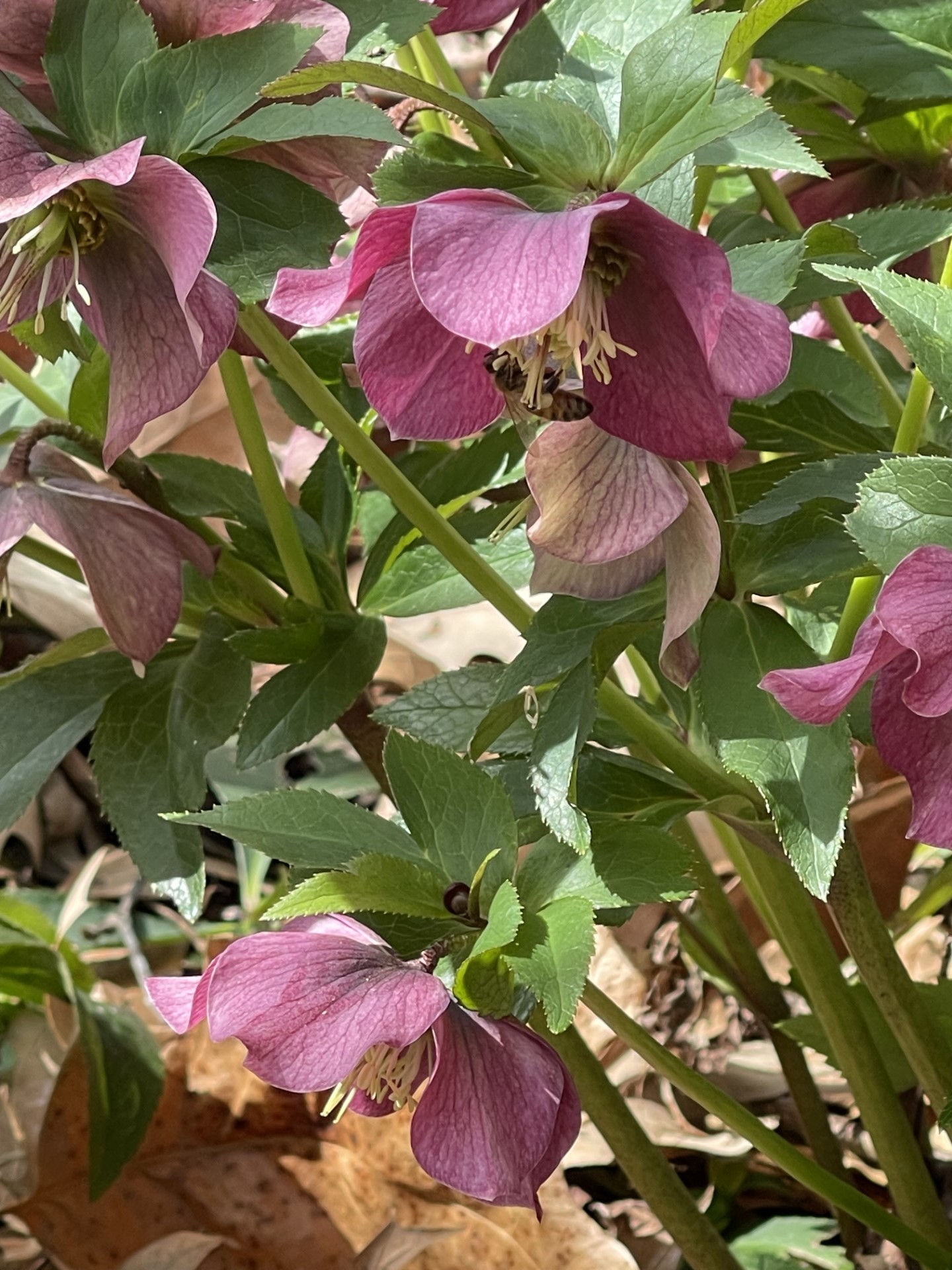
Helleborus orientalis: The genus name comes from the Greek word bora meaning “food” and helein meaning “injures/destroys” refers to the plant’s toxic leaves, stems, and roots which are poisonous to humans, dogs, cats, and horses if ingested.
Common Names: Hellebore, Lenten rose
Family: Ranunculaceae
Clumps of Hellebores/Lenten roses blooming in February or March are true harbingers of spring and provide an early nectar source for honey and native bees.
Helleborus orientalis is an herbaceous perennial native to Turkey and the Caucasus Mountains. It will grow well in Zones 4 to 9 in full or part shade in organically rich, moist, but well-drained soils. Helleborus requires medium moisture and is low maintenance, deer resistant, and can tolerate heavy shade, shallow-rocky soil, and air pollution. Hellebores will grow 1 to 1.5 feet in height and spread 1 to 1.5 feet. No serious insect or disease problems. Leaf spot and crown rot are occasional problems. A rugged and easy-to-grow plant.
Local bloom time is late February through March with blooms from white to rose-purple with yellow stamens. Flowers usually appear in clusters of 1-4 on thick stems rising above the foliage. Blooms in late winter and continues into spring, with a long, 8–10-week bloom period. Foliage is evergreen and provides winter interest. H. orientalis is best used in groups in shady locations, under trees or large shrubs, in woodland gardens, or on border fronts. It may also be incorporated into a naturalized area where clumps will slowly spread through self-seeding. H. orientalis may also be massed to form an attractive ground cover and it is a wonderful plant to use in a shady woodland setting.
Propagation can be done by seed, cutting, or division. Dividing a hellebore is quite easy. The best time to do so is in the fall before new foliage emerges or after it flowers and before the hot weather starts. Choose a healthy, mature plant and make sure it has multiple well-defined crowns. Divide each crown you may get anywhere from two to ten for each clump divided. Immediately replant and water the divided crowns.
References:
Missouri Botanical Garden
https://www.missouribotanicalgarden.org/
University of Wisconsin Extension
https://hort.extension.wisc.edu/articles/lenten-rose-helleborus-xhybridus/